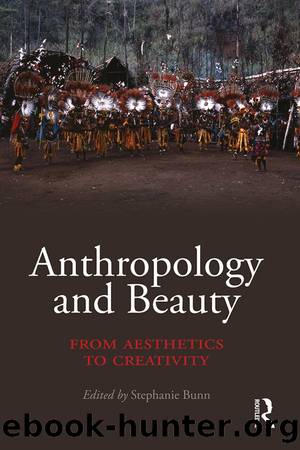
Anthropology and Beauty by Stephanie Bunn
Author:Stephanie Bunn [Bunn, Stephanie]
Language: eng
Format: epub
ISBN: 9781138928794
Barnesnoble:
Publisher: Taylor & Francis
Published: 2018-01-25T00:00:00+00:00
Beyond aesthetic relativism?
In this chapter I intended to respond to the volumeâs invitation to think âbeyond a purely aesthetic and relativist stanceâ. But has my analysis actually done so? I argued that racialised and other status hierarchies are not congruent with aesthetic hierarchies. This lack of congruency is important because the perception and response to fleshly beauty create affects and effects not entirely predicted by other forms of social domination and symbolism.
One objection to my argument, however, is that such affects and effects are themselves constructed, and therefore my analysis has not gone beyond the relativist stance. In one sense, but only a trivial one I believe, this objection is true. All phenomena are socially constructed in the sense that they can only be represented through symbolic means. There is no beauty âin itselfâ apart from what is perceived by a social being. But this notion of social constructionism is as reductive as the biologism that says all human action is caused by chemistry. A constructionist logic can be applied recursively to itself to show that its account of the world-as-constructed is also constructed, and hence a partial view. As Donna Haraway (1988) points out, seeing makes a world according to the capacities of a particular eye (human, fly, robot, etc.). Like any form of seeing, constructionism leaves some things in â and others out. As anthropologists we may never entirely be free, as it were, of the worlds we construct in our scholarship; yet we can investigate our intellectual blind spots, glimpse them obliquely.
In this chapter I asked: in what ways are the inheritance of beauty and responses to it not determined by social hierarchy and cultural meaning? Social constructionism grants agency to the abstraction of society (or history, discourse, biopower, etc.). We might also ask how this agency becomes entangled with â and sometimes limited by â other agencies, even if they are unknowable in themselves. One example of such agency is fleshly beauty, which can be perceived through effects it generates that are not rigidly determined by other forms of social organisation.
The beauty of youth, male and female, redirects the gaze and interest of society, away from the wisdom, spiritual powers and social capital of their elders. It could be said to impose some limits on the ability of social structures to reproduce themselves in the next generation. A woman may (illicitly or not) choose the beautiful male youth over the elder man her family or social group prefers for his wealth or status. Such âfatal attractionsâ may be more or less rare depending on social structure and individual daring, but they nevertheless have the potential to subvert the rules of marriage and alliance. The social effects of beauty can, in some situations, limit the powers of elders, injecting unpredictable dynamism to generational relationships and social reproduction.
If nature is democratic in its relative blindness to status markers when it allocates beauty, it is even more democratic in its indifference to such markers when it takes beauty away through physical decline.
Download
This site does not store any files on its server. We only index and link to content provided by other sites. Please contact the content providers to delete copyright contents if any and email us, we'll remove relevant links or contents immediately.
Cecilia; Or, Memoirs of an Heiress — Volume 1 by Fanny Burney(32559)
The Great Music City by Andrea Baker(32020)
Cecilia; Or, Memoirs of an Heiress — Volume 2 by Fanny Burney(31957)
Cecilia; Or, Memoirs of an Heiress — Volume 3 by Fanny Burney(31943)
We're Going to Need More Wine by Gabrielle Union(19049)
All the Missing Girls by Megan Miranda(16033)
Pimp by Iceberg Slim(14513)
For the Love of Europe by Rick Steves(14135)
Bombshells: Glamour Girls of a Lifetime by Sullivan Steve(14077)
Talking to Strangers by Malcolm Gladwell(13374)
Norse Mythology by Gaiman Neil(13371)
Fifty Shades Freed by E L James(13244)
Mindhunter: Inside the FBI's Elite Serial Crime Unit by John E. Douglas & Mark Olshaker(9345)
Crazy Rich Asians by Kevin Kwan(9293)
The Lost Art of Listening by Michael P. Nichols(7507)
Enlightenment Now: The Case for Reason, Science, Humanism, and Progress by Steven Pinker(7315)
The Four Agreements by Don Miguel Ruiz(6766)
Bad Blood by John Carreyrou(6623)
Weapons of Math Destruction by Cathy O'Neil(6282)
